
How Dealers Are Embracing AI

Artificial intelligence (AI) is no longer a future concept for outdoor power equipment dealers. It is already showing up in daily dealership work. From writing emails to diagnosing equipment issues, dealers are experimenting with tools that help them move faster and make better decisions.
A recent Dealer’s Edge community discussion brought together dealers, consultants, and industry professionals to share how AI is being used inside real dealerships today. The takeaway was clear. AI is not replacing people. It is helping dealership teams work smarter, reduce administrative work, and unlock insights from the data they already have.
Below are several ways dealers are beginning to apply AI across their operations.
AI for Everyday Administrative Work
Many dealerships start small. Administrative tasks are often the easiest place to see immediate value.
AI tools can generate professional responses to customer emails, letters, and messages in seconds. Tasks that once took 20 to 30 minutes can now take just a few minutes.
Dealers are using AI to:
- Draft customer emails and service responses
- Write marketing messages or campaign content
- Generate text messages for customer follow-ups
- Create internal documents and reports
AI also helps staff quickly draft professional responses to customer issues and organize large data sets, such as restructuring customer contact lists or email records in Excel. These tasks once required significant manual effort, but AI can complete them in seconds, freeing employees to focus more time on customers and dealership operations.
AI in Marketing and Market Analysis
Marketing is another area where dealers are seeing strong results.
AI can analyze customer data, sales history, and geography to help identify where a dealership wins the most business. Instead of guessing where to advertise, dealers can look at patterns in their data.
For example, a dealer might discover:
- A specific region where commercial mower sales are strongest
- Customer groups that purchase equipment repeatedly
- Areas where additional marketing could drive growth
Dealers are also using AI to evaluate marketing investments. One participant used AI to analyze market share, Google rankings, and potential return on investment before deciding whether to switch website providers. These insights help dealerships spend marketing dollars more effectively.
AI for Service Departments
Service departments generate a huge amount of data. Work orders, technician notes, and repair histories often sit unused inside dealer management systems.
AI helps turn that information into practical insights.
Two participants discussed several service applications:
- Converting technician notes into clear complaint, cause, and correction formats for service invoices
- Translating technician notes written in Spanish into English documentation
- Reviewing warranty claims to confirm required information is included
- Identifying common repair patterns across equipment models
For example, if dozens of work orders show the same belt replacement issue on a specific mower model, AI can identify the pattern. This helps dealers stock the right parts and prepare technicians for common failures.
Technicians are also using AI as a troubleshooting assistant. By describing an engine model and symptoms, they can receive suggested diagnostic steps within seconds.
The key lesson is simple. The better the question and context you provide, the better the AI response.
AI for Parts and Inventory Planning
Inventory management often relies on experience and intuition. AI allows dealers to support those instincts with real data.
By analyzing several years of sales history, AI can help identify:
- Seasonal demand for specific parts
- Fast-moving inventory items
- Parts that rarely sell during certain months
- Complementary products that stabilize revenue in slower seasons
Instead of reviewing spreadsheets manually, dealers can export their data and have AI organize and analyze it automatically. This approach helps parts managers make more informed ordering decisions and reduce overstock or shortages.
AI for Customer Follow-Ups and Retention
Customer retention is another area where AI offers strong potential.
Dealers often have thousands of customer records but limited time to follow up with everyone. AI can scan dealership data and identify customers who have not returned for parts or service.
For example, AI can flag:
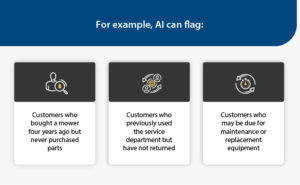
- Customers who bought a mower four years ago but never purchased parts
- Customers who previously used the service department but have not returned
- Customers who may be due for maintenance or replacement equipment
From there, dealerships can automatically send reminder emails or text messages encouraging customers to reconnect with the dealership. These automated reminders help maintain relationships without requiring staff to manually contact every customer.
AI for Training and Workforce Development
Hiring skilled technicians continues to challenge many dealerships. AI may also help address this problem.
Some industry leaders are exploring AI-generated training modules that deliver short learning sessions for employees. These modules could help train parts staff to handle basic technical knowledge or assist new technicians with diagnostics. Short training segments could allow dealerships to develop talent internally rather than relying entirely on external hiring.
AI as a Productivity Tool, Not a Replacement
Throughout the discussion, one theme appeared repeatedly. AI does not replace the human side of dealership operations.
Dealerships run on trust, relationships, and expertise. Customers still want advice from knowledgeable staff and experienced technicians.
AI simply supports that expertise by:
- Finding patterns in large data sets
- Reducing repetitive administrative work
- Providing quick research and insights
- Helping employees make faster decisions
The most successful dealers view AI as an assistant rather than a substitute.
AI Safety and Data Best Practices
AI is only as useful as the data you provide but it is just as important to use that data responsibly.
Dealers should avoid entering any sensitive or identifying information into AI tools. This includes customer names, phone numbers, addresses, financial details, or any private business data. Instead, use generalized or anonymized information when prompting AI.
Good practices to follow:
- Do not upload customer-identifiable information
- Avoid sharing financial, payroll, or confidential business data
- Use sample or anonymized data when testing prompts
- Review outputs before using them with customers
- Follow your company’s data privacy policies
AI tools are designed to assist, not store or manage sensitive dealership data. Keeping inputs clean, general, and non-identifiable ensures you get the benefits of AI without creating unnecessary risk.
When used properly, AI becomes a safe and effective tool that supports your team without compromising customer trust.
Getting Started with AI in a Dealership
Dealers who are exploring AI today often start with simple applications.
Good starting points include:
- Email writing and communication tasks
- Marketing and campaign planning
- Service documentation and diagnostics
- Customer data analysis
Another important step is organizing dealership data. AI tools rely on accurate information. Clean customer records, service histories, and equipment data make the results far more valuable. Many participants emphasized starting small. Focus on one department or process. Learn what works, then expand.