
The Hidden Costs of Choosing the Wrong Dealership Software
You know what good days in the dealership feel like. Tickets move. Phones get answered. Techs stay turning hours. Customers are taken care of, and you are not putting out fires every five minutes.
Your dealership software has a lot to do with how many of those days you get.
Something that looks affordable on paper can turn into a very expensive choice once your team is using it every day. Not because of the monthly invoice, but because of everything that comes with it: extra time on simple tasks, quotes and parts sales that never close, and customers and staff who slowly drift away.
That is what this post is about. The real cost of living with the wrong software.
Click to Jump Ahead:
- Wasted Time – When Your Team Is Fighting the Software
- Lost Revenue – The Sales You Never See
- Poor Decisions and Burned‑Out Staff – The Long Tail of a Bad System
Wasted Time – When Your Team Is Fighting the Software
One of the first places bad software shows up is in your team’s day.
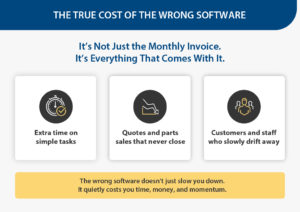
The work itself has not changed. You are still writing work orders, selling parts, scheduling jobs, and checking unit history. But every one of those tasks takes a bit longer than it should, because the software is getting in the way instead of getting out of it.
You see it when:
- Writing up a work order means clicking through several screens instead of one clear flow
- Ringing up parts takes extra steps just to find the right item or price
- Looking up a customer or unit feels like a guessing game, not a quick search
You also feel it in all the double entry that creeps in. Maybe your staff is typing the same information into:
- An OEM site
- A spreadsheet
- Your accounting program
None of this is exciting work. It is just extra keystrokes your team has to push through before they can actually help the customer in front of them.
Training new people gets harder too. Instead of learning “how we do things here,” they spend weeks learning “how to work around the system.” A manager or senior employee usually ends up playing help desk and losing part of their day to basic questions.
What “a few extra minutes” really costs
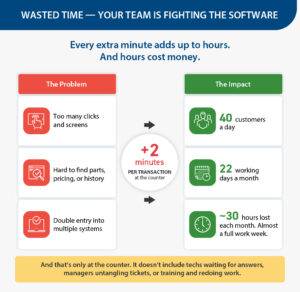
At the front counter, say your staff serve around 40 customers a day. If your software adds just 2 extra minutes to each transaction, that is 80 minutes gone every day.
Over a month with 22 working days, that is close to 30 hours.
Almost a full work week.
And that is only at the counter. It does not include the time techs stand and wait for answers, the time managers spend untangling tickets, or the extra time spent training and redoing work.
Once you see it like that, “a few extra clicks” is not a minor annoyance. It is a quiet labor cost you are paying for month after month.
Lost Revenue – The Sales You Never See
Wasted time is painful. Lost sales hurt even more.
The tricky part is that bad software usually does not lose you money in big, dramatic ways. It does it quietly. A few missed parts sales here. A unit deal that never quite comes together there. At the end of the month, it just feels like “we were a bit slow,” not “our software cost us real revenue.”
When you cannot say “yes” fast enough
Customers do not like waiting while someone fights a screen.
If your team cannot quickly answer simple questions like:
- “Do you have this part in stock?”
- “What will it cost to fix this?”
- “Can you get this unit for me and when?”
then a lot of people decide to “think about it” and check their phone in the parking lot. Once they are on Google, they are one click away from another dealer or an online retailer.
This is where slow or clunky software really bites:
- Parts look out of stock in the system when they are actually on the shelf
- Pricing is hard to trust, so staff hesitate or discount to get around it
- Quotes take so long to build that the customer loses patience
None of those moments show up on a report. They just feel like customers who “were not serious” or “were only shopping around.”
What two missed tickets a day looks like
Think about your parts counter.
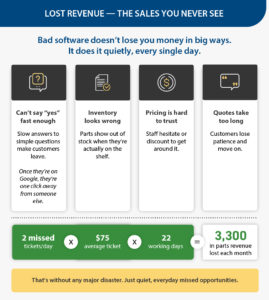
Say you turn away just two parts customers a day because the software says “no stock” when you actually have it or could have sourced it quickly.
If your average ticket is $75, that is about $150 in missed sales every day.
Over 22 working days in a month, you are looking at roughly $3,300 in parts revenue you never see.
That is without any major disaster. No angry blow ups. Just a couple of customers a day who were ready to buy and heard “no” when the right tools might have helped you say “yes.”
Death by “slow month”
The same thing happens on the whole goods and service side:
- A sales quote that takes too long to pull together
- A service estimate that is missing parts or labor because history is hard to see
- A promised call back that slips through the cracks
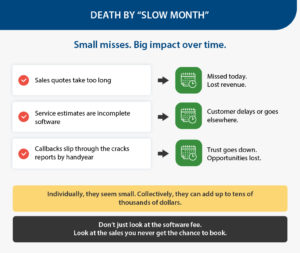
Each one on its own is easy to explain away. Busy day. Short staffed. Customer was just looking. But over a season, those missed chances can easily add up to tens of thousands of dollars.
That is why looking only at the software fee can be misleading. The larger cost is often the sales you never get the chance to book.
Poor Decisions and Burned‑Out Staff – The Long Tail of a Bad System
Some costs hit you right away. Others sneak up over months and seasons. Bad software does both.
The “long tail” shows up in two big areas: the decisions you make and the people you rely on.
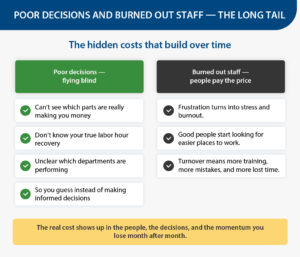
Flying blind on the numbers
Most dealers are not short on reports. They’re short on reports they can actually trust and use.
When your software makes reporting painful, you end up guessing on things you should be able to see clearly, like:
- Which parts are really making you money
- How many labor hours you are actually recovering
- Which departments are carrying the load and which are falling behind
So you make calls based on gut feel:
- Keeping someone on the schedule because “it feels busy”
- Discounting a job because “that seems high”
- Ordering inventory because “we always sell these”
Sometimes those guesses are right. When they are wrong, they can get expensive.
Here is one simple example.
If your shop labor is underpriced by just $5 per hour because you do not have clear numbers, and you sell around 400 billable hours a month, that is 5 × 400 = $2,000 left on the table every month.
Nothing dramatic. No major blow up. Just a quiet miss that repeats itself over and over.
The wear and tear on your team
The other slow cost is the toll on your people.
Most dealers have at least one “power user” who everyone leans on to make the software behave. They know the tricks. They know the workarounds. They catch the mistakes. They keep things moving.
That is great, until it is not.
Over time, clunky tools can:
- Wear out your best service writers and parts people
- Turn every bigger job into a “project” instead of a simple process
- Make good staff feel like they are fighting the software more than they are helping customers
Those are often the people you can least afford to lose. Replacing them is not just about hiring someone new. It is:
- Weeks of training and lower productivity
- More mistakes while they learn the quirks of the system
- More time pulled from managers and senior staff to support them
Even if that kind of turnover only happens once every few years, the hit is real. It is time, money, and energy you did not plan to spend.
When you add that to the missed margin from bad pricing, the wrong inventory calls, and fuzzy visibility into each department, you start to see the full picture.
The wrong software is not just a daily annoyance. Over time, it can quietly shape your decisions and burn out the people who are trying hardest to keep the dealership running well.
Conclusion – Do Not Just Look at the Price Tag
On the surface, software looks like a simple line item. You see a monthly price, compare a few options, and it is easy to pick what seems “good enough.”
By now, you can see the real cost of it lives somewhere else.
When you look at new software, or rethink what you are using now, try shifting the questions you ask:
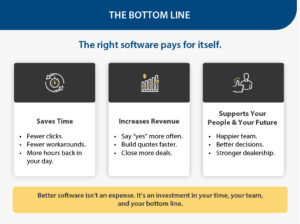
- How much time will this actually save my team each day
- How many more quotes, parts tickets, or jobs can we realistically get out the door
- Will this make it easier to keep good people and give customers a smoother experience
The goal is to choose the right software the first time, before you spend months (and a lot of energy) living through a painful implementation that still leaves you with the same problems.
If you want a quick gut check, try this in your store over the next week:
- Notice every time someone says “the computer is slow today”
- Notice every time you lose track of a follow up or have to redo a ticket
- Put a rough number beside those moments, even if it is just “we lost ten minutes here” or “we probably lost that sale”
Do that for a few days and you will have your own picture of what your current setup is really costing you.
See How IDEAL Can Save Time and Generate More Revenue